Early Access Program — Platform Validation Phase

510(k) Classification, Predicate Analysis,
and Gap Analysis Platform

Determine device class and product code. Identify optimal predicates from 180,000+ cleared devices. Generate SE matrices, gap analyses, and strategy reports with complete FDA citations.

Built for regulatory teams who need verifiable evidence, not black-box AI.

Supported through these programs

ChaiTech Accelerator Innovation Booster Zone (TMU) Brampton Venture Zone (TMU) MATTER Health (Chicago) Social Ventures Zone Toronto Metropolitan University University of Toronto ChaiTech Accelerator Innovation Booster Zone (TMU) Brampton Venture Zone (TMU) MATTER Health (Chicago) Social Ventures Zone Toronto Metropolitan University University of Toronto
The Challenge

The 510(k) Preparation Challenge

Device classification requires systematic analysis across hundreds of FDA product codes. Predicate identification demands review of thousands of cleared devices to identify defensible comparators.

SE determination requires documented comparison across indications, technological characteristics, and performance specifications. Gap analysis must identify performance data, testing protocols, and standards needed to address questions of safety and effectiveness.

Each classification decision requires FDA-sourced evidence. Each predicate selection needs documented rationale. Each gap demands specific remediation with standards citations. Each submission requires complete audit trails.

The Veridocx Approach

Veridocx provides the regulatory intelligence infrastructure to deliver these analyses faster—without compromising the rigor required for FDA submissions.

Complete Platform

Complete 510(k) Workflow

From device classification to gap analysis and strategy reports—computational methods and FDA-sourced data supporting each phase of 510(k) preparation.

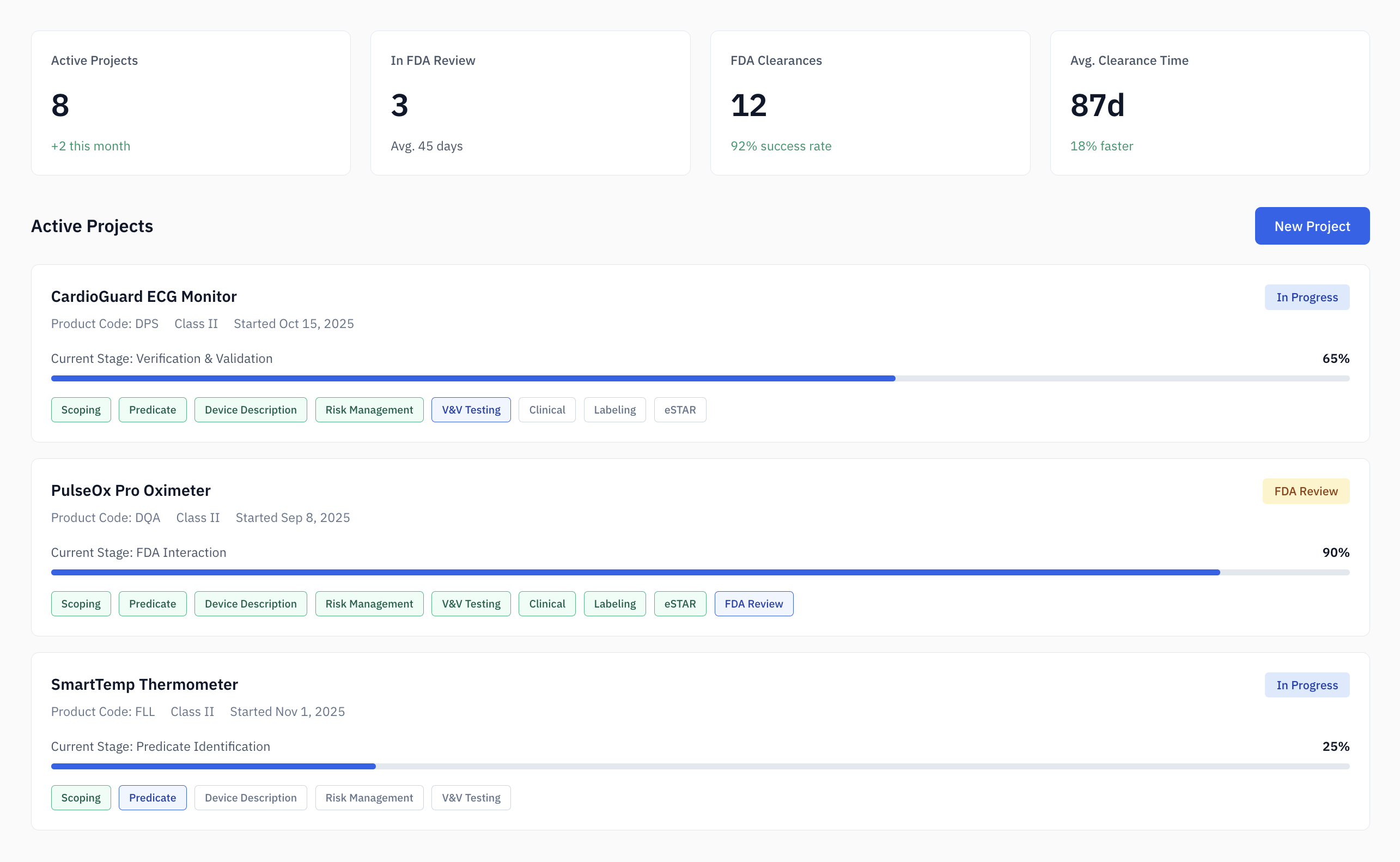
Project Dashboard

Manage multiple 510(k) projects with centralized tracking of classifications, predicate analyses, SE comparisons, and submission milestones.

Veridocx Dashboard Interface
Core Capabilities

What You Get

Four critical capabilities for 510(k) preparation—from classification to strategy reports.

1

Classification & Predicate Identification

Determine device class and optimal FDA product code through systematic pathway analysis. Search 180,000+ cleared 510(k) submissions to identify predicates with similarity scoring across indications, technology, and regulatory history. Results include k-number, clearance date, predicate chain analysis, and confidence metrics.

Device class determinationProduct code analysisPredicate rankingSimilarity scoring
2

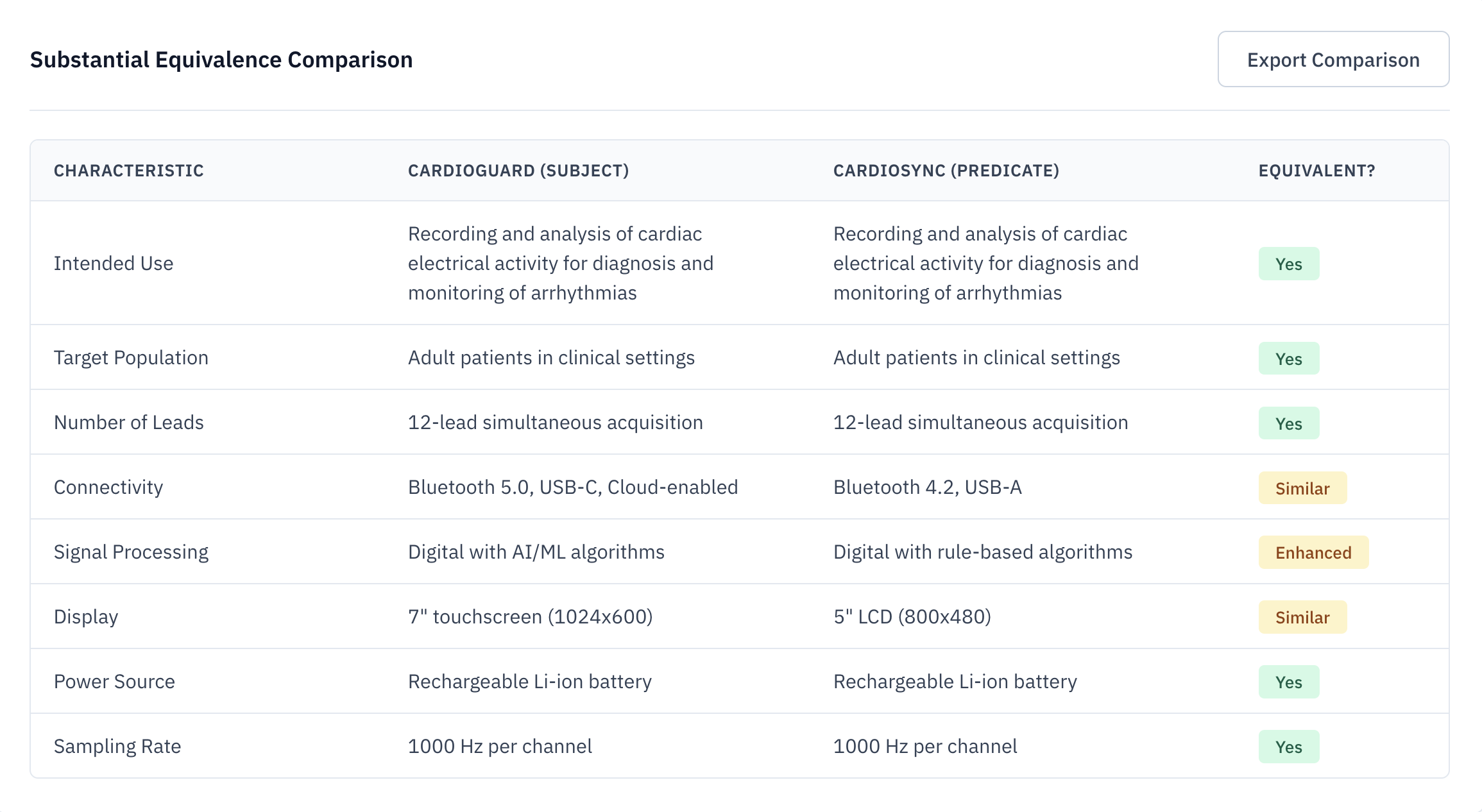
Substantial Equivalence (SE) Matrix

Automated comparison against selected predicates across indications, technological characteristics, and performance specifications. Identifies critical similarities and flags differences that may raise questions of safety or effectiveness—the foundation of FDA's SE determination.

Indications comparisonTech characteristics analysisPerformance specs mappingCritical difference flagging
3

Gap Analysis & Remediation Planning

Identify regulatory gaps arising from predicate differences. Get specific testing recommendations (e.g., ISO 10993-5/10/18 for biocompatibility), FDA-recognized standards mapping, labeling analysis, and risk-based assessments. Each gap includes priority level and remediation roadmap with citations.

Performance evidence gapsStandards mappingLabeling/claims analysisTesting recommendations
4

Strategy Report Generation

Synthesize all analyses into submission-ready documentation. Combines classification rationale, predicate justification, SE matrix, gap analysis, and remediation plan—all with FDA citations, confidence metrics, and audit trails. Export in eSTAR-compatible formats (PDF, DOCX, CSV).

Comprehensive synthesisFDA source citationseSTAR-compatible exportComplete audit trails
Regulatory-Grade Methodology

Built for Regulatory Compliance, Not Just Speed

Medical device submissions require defensible evidence and deterministic validation. Veridocx combines regulatory rule engines, FDA database analysis, and computational reasoning—with full traceability.

Deterministic Validation

Classification rules and submission requirements derived directly from FDA guidances (21 CFR 862-892). Deterministic rule-based validation ensures compliance—no hallucinations on regulatory requirements.

FDA Precedent Analysis

Systematic search across 180,000+ cleared 510(k) submissions and 7,000+ product codes. Identify predicates based on device characteristics, indications, and regulatory history—not keyword matching.

Complete Audit Trails

Every recommendation includes FDA citations, confidence scores, and reasoning chains. Export documentation ready for RA/QA review with full traceability.

By The Numbers

7,042
FDA product codes with classification data
180,000+
Cleared 510(k) submissions analyzed
100%
Of outputs include FDA source citations
Weekly
Synchronization with FDA databases

Quality Assurance & Validation

Development Process

  • Built in collaboration with regulatory consultants and RA/QA professionals
  • Continuous validation against FDA guidance documents and CFR regulations
  • Regular synchronization with FDA database updates and regulatory changes

Output Standards

  • Complete audit trails with source citations and confidence metrics
  • eSTAR-compatible export formats (PDF, DOCX, CSV) for submission readiness
  • Version-specific standards citations with applicability justification
Technical methodology white paper in preparation

Why Methodology Matters

Regulatory submissions require deterministic validation, FDA-grounded evidence, and complete audit trails—not black-box predictions. Our approach ensures every output is traceable and regulatory-grade.

Built for Regulatory Rigor

Our commitment to regulatory standards guides every aspect of platform development

Developed with Regulatory Professionals

Continuous collaboration with regulatory consultants, RA/QA directors, and medical device manufacturers ensures our approach meets real-world regulatory requirements.

Always Current with FDA Databases

Nightly synchronization with FDA 510(k) databases, product classification data, and consensus standards ensures recommendations reflect current regulatory landscape.

Validated Against Regulatory Standards

Every output undergoes validation against FDA guidances and CFR regulations. Our methodology prioritizes the rigor regulatory teams apply to submissions.

Our goal: provide regulatory teams with computational tools that meet the same standards of rigor they apply to FDA submissions.

Security & Privacy

Enterprise-Grade Security

Your regulatory data remains private, secure, and under your control

Encryption

TLS 1.2+ in transit, AES-256 at rest

Access Control

Role-based permissions with audit trails

Data Privacy

No model training on your private data

Compliance

Built for regulatory submission standards

Data Protection & Privacy

All projects are encrypted in transit and at rest. Role-based workspaces maintain audit trails for key actions. Your data remains private—we do not use customer data to train models.

Access & Audit Controls

  • Role-based access control (RBAC) for team workspaces
  • Complete audit trails for regulatory submission traceability
  • Confidence scores and source citations on all outputs

Important Notice

Veridocx is an AI software tool for document preparation and research support. It does not provide legal or regulatory advice. All outputs should be reviewed by qualified regulatory professionals before submission to regulatory authorities.

About Us

About the Team

Veridocx was built by a team from University of Toronto, University of Waterloo, and Arizona State University with backgrounds in Computer Science, Computer Engineering, and Biotechnology. After working on ML research, data engineering, and medical device projects, we identified a critical gap: regulatory preparation is essential but unnecessarily slow and fragmented.

We're applying AI to make 510(k) preparation faster and more defensible—not to replace expert judgment, but to give RA/QA professionals credible starting points, structured evidence, and exportable rationale grounded in FDA data.

Meet the Team

Olivia Charles headshot

Olivia Charles

CEO/CRO

MHSc Bioethics, Business & Life Sciences, University of Toronto. Research focus: Regulatory frameworks and medical device policy.

Cole Connelly headshot

Cole Connelly

CFO/COO

Cell & Molecular Biology and Immunology, University of Toronto. Background in life sciences research and medical device development.

Jonas Martins headshot

Jonas Martins

CTO

Computer Engineering & AI, University of Toronto. Research interests: Knowledge graphs, semantic search, regulatory AI systems.

Maaz Ahmed headshot

Maaz Ahmed

Tech Lead

MS Software Engineering, Arizona State University. Technical focus: Distributed systems and regulatory data processing.

Matthew Li headshot

Matthew Li

Full-stack Engineer

Computer Science & Business, University of Waterloo. Expertise in full-stack development and regulatory platform architecture.

Pricing

Early Access Pricing

Free during platform validation phase. Professional plans coming soon.

Early Access

Platform Validation Phase

Free

Full platform access with usage limits

  • Complete 510(k) workflow (all 5 steps)
  • Access to 180,000+ 510(k) database
  • Gap analysis with standards mapping
  • Export in PDF, DOCX, CSV
  • Usage limits: 5 projects per month during validation phase
Coming Soon

Professional

For RA teams and consultants

Custom

Contact for enterprise pricing

  • Everything in Early Access
  • Unlimited projects
  • Priority support
  • Team workspaces with RBAC
  • API access (coming)

Need custom deployment or compliance requirements?
Contact us for enterprise options

FAQ

Frequently Asked Questions

Everything you need to know about Veridocx.

Still have questions?

Contact Support
Get Started

Request Early Access

Join our platform validation phase or subscribe for technical updates and methodology insights.

Or subscribe for updates: